
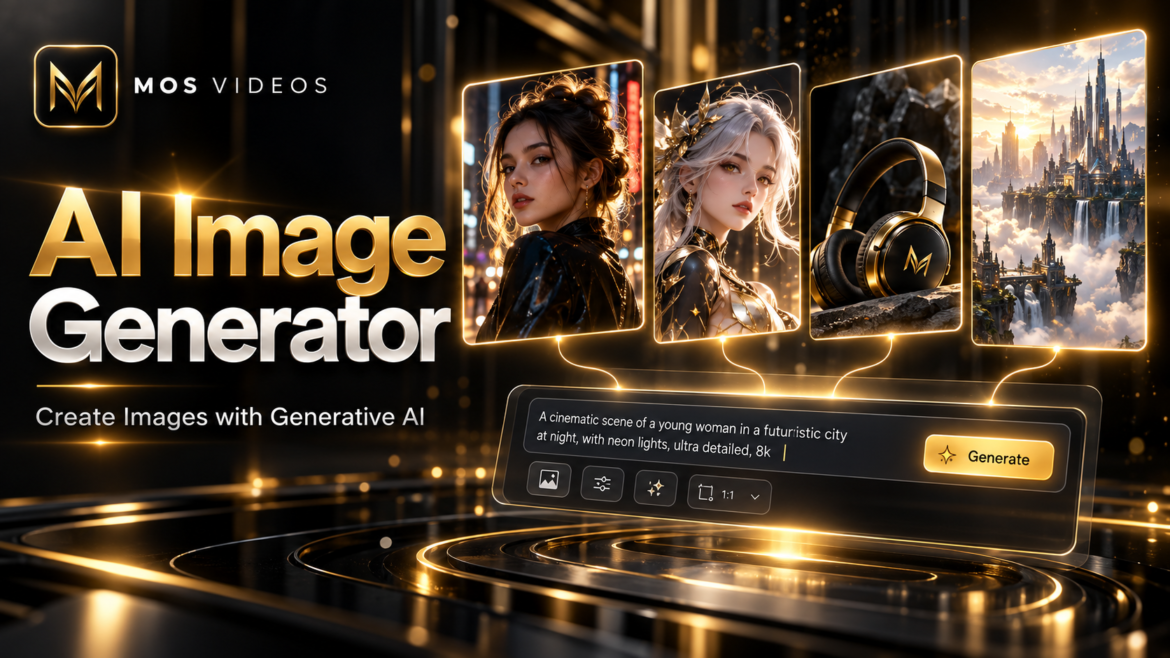
Artificial intelligence has changed the way digital images can be created.
An AI Image Generator allows users to create visual content from text prompts, references, ideas, and other forms of input using generative artificial intelligence.
Instead of manually designing every visual element, creators can describe what they want to see.
For example:
A futuristic city at sunset, cinematic lighting, flying vehicles, dramatic clouds, photorealistic style.
An AI image generation system can interpret that description and create a new visual composition based on the prompt.
This technology is now being used by designers, marketers, filmmakers, content creators, advertisers, social media teams, and businesses.
Platforms such as MOS Videos expand this workflow further by connecting AI image generation with video and audio creation.
In this guide, you will learn what an AI Image Generator is, how it works, how to create better AI images, and how image generation fits into modern multimodal content creation.
What Is an AI Image Generator?
An AI Image Generator is a generative artificial intelligence system that creates new images based on text prompts, visual references, or other instructions.
Instead of selecting an existing photograph from a database, generative AI can create entirely new visual content.
Users can describe elements such as:
- Subject
- Environment
- Lighting
- Camera angle
- Colors
- Composition
- Mood
- Visual style
- Materials
- Level of realism
The AI then interprets those instructions and generates an image designed to match the request.
How Does an AI Image Generator Work?
AI image generators use machine learning models trained to understand relationships between language and visual information.
When a user writes a prompt, the system analyzes the words and identifies concepts associated with the description.
For example:
A black sports car parked in a futuristic city at night with cinematic neon lighting.
The system identifies concepts including:
Subject: black sports car
Environment: futuristic city
Time: night
Lighting: neon and cinematic lighting
Style: cinematic
The AI then generates a visual composition based on these concepts.
A simplified workflow looks like this:
- The user writes a prompt.
- The AI analyzes the text.
- The model identifies visual concepts.
- The system generates image information.
- Details are refined.
- The final image is created.
What Is Text-to-Image AI?
Text-to-Image AI is the technology that allows artificial intelligence to create images from written descriptions.
It is one of the most common forms of AI image generation.
A user can write:
A medieval castle on a mountain surrounded by clouds during sunrise.
The AI attempts to generate that scene without requiring an existing photograph.
Text-to-image systems can interpret many types of information, including:
- Objects
- People
- Places
- Artistic styles
- Lighting conditions
- Camera angles
- Materials
- Colors
- Atmosphere
This makes text-to-image generation highly flexible for creative work.
What Can an AI Image Generator Create?
AI image generators can produce many types of visual content.
Examples include:
- Photorealistic images
- Illustrations
- Concept art
- Product concepts
- Social media graphics
- Advertising visuals
- Fantasy environments
- Science-fiction scenes
- Character designs
- Marketing imagery
- Thumbnails
- Storyboards
- Cinematic frames
The quality and style of the result depend heavily on the AI model and the prompt.
How to Create Images With AI
Creating AI-generated images usually begins with a simple idea.
The process can be divided into a few steps.
1. Define the Main Subject
Start by describing the most important element of the image.
For example:
A futuristic astronaut
or:
A luxury sports car
The subject should be clear enough for the model to understand what deserves visual attention.
2. Add the Environment
Next, describe where the subject appears.
Examples include:
- Futuristic city
- Desert
- Mountain landscape
- Luxury studio
- Cyberpunk street
- Tropical beach
- Alien planet
- Modern office
Environment plays an important role in determining the final composition.
3. Describe the Lighting
Lighting can dramatically change an image.
Useful terms include:
- Cinematic lighting
- Golden hour
- Neon lighting
- Soft studio lighting
- Dramatic shadows
- Moonlight
- Volumetric lighting
- Natural daylight
For example:
A futuristic motorcycle in a dark city, cinematic neon lighting reflecting on wet streets.
That prompt provides much more visual direction than simply requesting a motorcycle.
4. Define the Camera and Composition
Photography terminology can help AI models understand composition.
Examples include:
- Close-up portrait
- Wide-angle shot
- Low-angle shot
- Aerial view
- Macro photography
- Portrait photography
- Product photography
- Cinematic framing
- Symmetrical composition
For example:
Wide-angle cinematic view of a futuristic city.
This describes not only the subject but how it should appear visually.
5. Add a Visual Style
The style helps define the overall aesthetic.
Possible examples include:
- Photorealistic
- Cinematic
- Minimalist
- Editorial
- Fantasy
- Science fiction
- Surreal
- Vintage
- Luxury advertising
- Digital illustration
Style instructions should support the intended use of the image.
How to Write Better AI Image Prompts
One useful prompt structure is:
Subject + Action + Environment + Composition + Lighting + Style
For example:
A futuristic female astronaut standing beside a spacecraft on Mars, wide cinematic composition, dramatic sunset lighting, realistic materials, photorealistic science-fiction style.
This gives the model information about:
- Main subject
- Location
- Composition
- Lighting
- Materials
- Visual style
More structured prompts often make the creative intention clearer.
Basic Prompt vs Detailed AI Image Prompt
A basic prompt:
A futuristic city.
A more detailed version:
A futuristic megacity at night, massive skyscrapers, flying vehicles, wet streets reflecting neon lights, cinematic wide-angle composition, atmospheric fog, photorealistic style.
The second prompt gives the AI more semantic information.
Instead of simply identifying the subject, it describes the desired visual experience.
How to Create Realistic AI Images
Realistic AI images usually require consistent visual instructions.
Several factors can help.
Use Photography Language
Terms related to photography can provide useful visual context.
Examples:
- Portrait photography
- Studio lighting
- Shallow depth of field
- Wide-angle lens
- Natural skin texture
- Cinematic composition
Describe Materials
Physical materials can influence realism.
For example:
- Brushed metal
- Transparent glass
- Leather
- Wet concrete
- Fabric
- Polished plastic
Keep the Scene Coherent
A prompt containing too many conflicting ideas may make generation more difficult.
A clear visual concept is usually easier to interpret.
AI Photo Generator vs AI Image Generator
The terms AI Photo Generator and AI Image Generator are closely related, but users may have slightly different intentions when searching for them.
An AI Image Generator can create many visual styles, including:
- Illustrations
- Digital art
- Graphics
- Concepts
- Photorealistic scenes
An AI Photo Generator usually implies a stronger focus on images designed to resemble photography.
Both use generative AI to create visual content.
The main difference is usually the intended aesthetic rather than a completely different underlying concept.
AI Picture Generator vs AI Image Generator
“AI Picture Generator” is another commonly used search phrase related to AI-generated visual content.
In practice, users searching for:
AI Image Generator
AI Picture Generator
and
AI Photo Generator
are often looking for similar capabilities.
They want to create new visual content using artificial intelligence.
For SEO, these terms are therefore semantically related and can naturally appear in the same broader topic cluster.
AI Image Generation for Content Creators
Content creators can use AI-generated images in many workflows.
Examples include:
- YouTube thumbnails
- Social media visuals
- Storytelling
- Character concepts
- Backgrounds
- Video scenes
- Short-form content
- Promotional graphics
AI image generation can also serve as the first stage of a larger video workflow.
For example:
Prompt → AI Image → Image-to-Video → Editing → Audio
This relationship between image and video generation is especially important for creators using generative AI.
AI Image Generation for Marketing
Marketing teams can use AI image generators for creative experimentation.
Potential applications include:
- Campaign concepts
- Advertising ideas
- Product visualizations
- Social media content
- Website visuals
- Presentation concepts
- Brand storytelling
AI can help teams rapidly explore different visual directions before deciding which ideas should move into larger production workflows.
AI Image Generation for Filmmaking
Filmmakers and visual creators can use AI image generation during pre-production.
Possible applications include:
- Concept art
- Character design
- Storyboards
- Location concepts
- Costume visualization
- Shot planning
- Environment design
An AI-generated image can also become the first frame of an Image-to-Video AI sequence.
This connects image generation directly with AI filmmaking.
AI Image Generator and Image-to-Video AI
One of the most powerful workflows in generative media combines image and video generation.
The creator begins by producing the desired visual.
For example:
An astronaut standing on an alien planet.
Once the image is created, Image-to-Video AI can add:
- Character movement
- Camera motion
- Environmental motion
- Atmospheric effects
- Lighting changes
The process becomes:
Prompt
→ AI Image
→ Image-to-Video
→ AI Video
This gives creators more control over the visual starting point before motion is introduced.
AI Image Generation and Multimodal AI
Modern AI creation is increasingly becoming multimodal.
Instead of generating only one type of media, creators can move between:
Text
→ Image
→ Video
→ Audio
This means an AI-generated image can become part of a much larger production.
For example:
A written idea becomes an image.
The image becomes a video.
The video receives narration.
Music and sound effects complete the experience.
How MOS Videos Fits Into AI Image Generation
MOS Videos is designed around AI-powered creative workflows involving images, video, and audio.
AI image generation can therefore become one part of a larger creative process.
A creator might begin by generating the visual concept of a scene.
That image can then become the foundation for:
- AI video
- Image-to-video animation
- Social media content
- Advertising
- Storytelling
- Creative experimentation
This allows creators to move between multiple media formats rather than treating each AI tool as an isolated process.
MOS Videos brings these forms of generative creation into a broader multimodal ecosystem.
Benefits of Using an AI Image Generator
AI image generators offer several potential advantages.
Rapid Visual Experimentation
Creators can explore multiple ideas quickly.
Accessible Creative Production
Users do not necessarily need advanced illustration skills to explore complex visual concepts.
Flexible Art Direction
Prompts can be modified to test different:
- Lighting
- Characters
- Locations
- Styles
- Colors
- Compositions
Connection With Video Generation
Generated images can become source material for AI video creation.
Creative Prototyping
Images can help visualize an idea before committing to a larger production.
Limitations of AI Image Generation
AI image generation still has limitations.
Potential issues include:
- Incorrect anatomy
- Inconsistent text
- Visual artifacts
- Unexpected objects
- Character inconsistencies
- Incorrect proportions
- Prompt misunderstandings
Complex scenes often require several generations and refinements.
Prompt quality also matters.
The best workflow is often iterative rather than expecting every first generation to be perfect.
Is AI Image Generation Replacing Designers?
AI image generators change how certain creative tasks can be performed, but they do not eliminate the importance of creative direction.
Human creators still make decisions about:
- Concept
- Composition
- Story
- Brand identity
- Taste
- Selection
- Editing
- Visual communication
AI can generate possibilities.
The creator determines which possibilities are useful.
This makes AI image generation a creative tool rather than a substitute for every part of professional design.
Is AI Image Generation the Future of Visual Content?
AI image generation is becoming an important part of digital creative workflows.
The major change is not simply that artificial intelligence can generate pictures.
The larger shift is that users can communicate visual ideas using natural language.
A creator can describe a concept and immediately begin exploring visual versions of that idea.
When combined with video and audio generation, AI image creation becomes part of a much larger transformation in digital content production.
Key Takeaways
- An AI Image Generator creates images using generative artificial intelligence.
- Text-to-Image AI converts written descriptions into visual content.
- Strong prompts describe subjects, environments, composition, lighting, and style.
- AI images can be used for social media, marketing, filmmaking, design, and storytelling.
- AI-generated images can become the starting point for Image-to-Video AI.
- MOS Videos connects AI image creation with broader video and audio generation workflows.
Frequently Asked Questions
What is an AI Image Generator?
An AI Image Generator is a generative artificial intelligence system that creates new images based on text prompts, references, or other instructions. It can generate photographs, illustrations, concept art, marketing visuals, and many other forms of digital imagery.
How does an AI Image Generator work?
AI image generators analyze the concepts described in a prompt and use generative models to create a visual composition matching those instructions. The system can interpret subjects, environments, lighting, styles, colors, and composition.
Can AI generate realistic images?
Yes. AI image generators can create photorealistic images, although quality varies depending on the model, prompt, subject complexity, and desired level of realism.
How do I write a good AI image prompt?
A useful AI image prompt should describe the subject, environment, composition, lighting, visual style, and other important characteristics. Clear and coherent prompts generally give the AI more information about the desired result.
What is Text-to-Image AI?
Text-to-Image AI is generative technology that creates images based on natural-language descriptions. Users describe what they want to see, and the AI generates visual content based on the prompt.
Can AI images be turned into videos?
Yes. AI-generated images can be used as source material for Image-to-Video AI systems, which generate movement, camera motion, and additional frames based on the original image.
What can AI-generated images be used for?
AI-generated images can support social media, marketing, filmmaking, advertising, concept design, presentations, storytelling, thumbnails, creative experimentation, and other visual projects.
What is MOS Videos?
MOS Videos is an AI creative platform focused on generative workflows involving video, image, and audio creation, allowing creators to develop content across multiple AI-powered media formats.